Fram Reports
Whatever happened to Karim Ali Fathi…?

 One of those players who didn’t make it as high as they wanted. For different reasons. I remember one of them: the passing of his mum, unexpectedly. And a few injuries that prevented him from reaching his full potential – but what do I know…
Two British Junior Open titles, 10 PSA trophies and a career-high world ranking of 33. And a smile to crack the saddest mood… Then came a new challenge: guiding professionals and developing the next generation in Maadi, Cairo, Egypt.
The story of a player whose squash journey now continues from the other side of the court door.
Having a good run on the PSA Tour
Born on 30 May 1993 in Cairo, he joined the PSA in 2009. His highest world ranking, No.33, came in September 2017. Ten titles from seventeen finals…


Karim made his name in Sheffield. In 2006, he won the British Junior Open Under-13 title. Two years later, he took the Under-15 crown, beating Pakistan’s Nasir Iqbal 9-2, 9-6, 9-1. Two victories in a tournament that brings young players up against the best of their generation.
Moving from junior squash to the professional tour means starting again, and quickly, 2012 brought a remarkable breakthrough.


2012, The Breakthrough – 19 yo and 5 titles in a year!
At the London Open in November 2012, Karim was unseeded. That did not stop him from removing Jonathan Kemp, then world No.29, before meeting Chris Ryder in the final. At nineteen, he was facing a very talented and experienced thirty-two-year-old player.

 Ryder forced a fifth game. Karim regained control and won after ninety minutes: 8-11, 11-8, 11-4, 9-11, 11-6. It was his fifth PSA title of the year, and of his career.
Based in the UK and working with Phil Whitlock, the young prospect was already proving he could win consistently among the professionals.
20213: Fighting back in Saskatoon
Canada, November 2013. In the Saskatoon Boast Open final, Martin Knight held four game balls at 10-6 in the third. Karim saved them and took the game 12-10.

There was also an interruption to treat a cut on his knee. When play resumed, the contest remained tight. Karim eventually prevailed 11-4, 6-11, 12-10, 11-9 after 102 minutes. At twenty, he became the tournament’s first Egyptian champion and collected his eighth PSA title: the match itself tells a story of resilience: a game almost lost, a medical interruption, then the ability to reset and finish the job.
2014: Winning in Malaysia and Valencia
Taking on the established names
At the 2015 World Championship in Seattle/Bellevue, Karim beat Peter Barker and Fares Dessouky to reach the last sixteen. His run ended against Grégory Gaultier, who went on to win his first-ever world title.


The following year, at the World Championship held at Wadi Degla, he defeated Cameron Pilley in the opening round and then Omar Abdel Meguid. He reached the last sixteen again, this time facing Mohamed ElShorbagy. Those results offer a clearer sense of his ability than a ranking alone: Karim could trouble established opponents on the sport’s biggest stages.


From Wadi Degla to Maadi
Karim joined Wadi Degla after retiring from professional competition in 2021 and coached there for four years.
He coached well-known Egyptian juniors/players Yehia ElNawasany, Mostafa El Sirty, Nour Aboulmakarim, Chris Baddour, and Taha El Shafei, not to mention Karim El Hammamy and Nadine Shahin.


He then became head coach at Maadi Club while continuing to work with professional players. His list includes Nardine Garas, Mohamed Gohar, Mohamed Sharaf, Yassin Shohdy and Canada’s Karim Aguib Michael, and he started developing a junior programme involving around one hundred children in Maadi.

Recognised by the Minister of Youth and Sports, Ahmed Sobhy
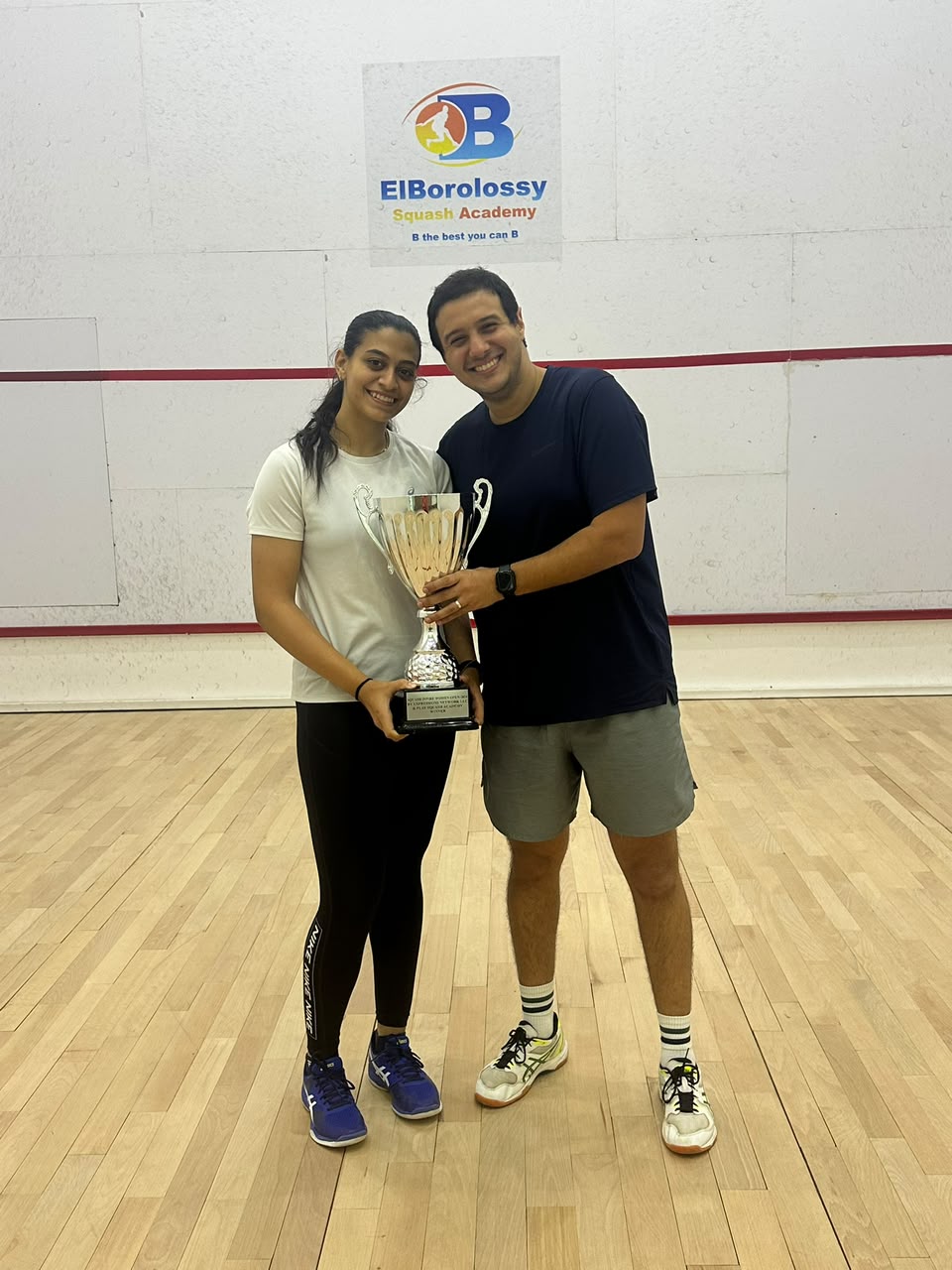
The trophy changes hands
His ten titles belong to his playing career. The victories of the players he supports belong to theirs, with the work of the teams around them. For the former world No.33, this is another way to take part in competition: helping a player find solutions, then watching them put those solutions into practice.
Today, his own account leads us to Maadi, to his professionals and to around one hundred children. The game goes on.
And in Karim Ali Fathi’s album, the trophies are now finding their way into other hands, Elhamdoulilah very much…